

What Every First-Year Law Student Wishes They Knew: Common Mistakes and Smart Strategies
“I wish someone had told me this before my first semester.”
It’s a thought shared by many law students after experiencing the realities of legal education.
According to research from the Law School Admission Council (LSAC), more than two out of five first-year law students seriously consider leaving law school during their first year.
The reason is rarely a lack of intelligence or potential. Instead, many students discover that law school requires an entirely different way of thinking, learning, and solving problems than they expected.
The good news is that many of these challenges are predictable. By understanding the lessons experienced law students wish they had known from the beginning, you can avoid common mistakes, develop stronger study habits, and build confidence throughout your legal education.
Table of Contents
1. Getting Into Law School Is Only the Beginning
You worked hard to earn your place in law school.
Months – sometimes years – of preparation, exams, and determination finally paid off.
Then came the first few weeks.
Suddenly, it felt like everyone else understood the lectures. Cases were difficult to follow. The workload kept growing. You started wondering if you were studying the right way – or if you were even good enough.
If you’ve felt this way, you’re not alone.
Don’t think that finishing your A/Ls and getting into the faculty means your academic struggles are over. That’s where they actually start.
– Sanushika Sooriyabandara, Second-Year Law Student
This is one of the biggest surprises first-year law students experience. Getting into law school is an achievement, but succeeding there requires a completely different approach to learning.
Unlike school, law school isn’t designed to test how much you can remember. It challenges you to interpret legal principles, analyse facts, evaluate arguments, and apply the law to unfamiliar situations. That shift can feel overwhelming at first – but it’s also a normal part of becoming a law student.
The earlier you understand this, the sooner you can stop questioning whether you belong and start focusing on developing the skills that legal education is designed to build.
2. What Do I Wish Someone Had Explained on Day One?
If I could go back to my first day of law school, I wouldn’t ask for a reading list or a shortcut to better grades. I’d simply want someone to explain what law school is really like.
There are a few lessons that almost every first-year student learns the hard way – but knowing them early can make the transition much smoother.
1. Feeling overwhelmed is normal
Almost everyone feels lost during the first few weeks, even if they don’t show it. Law school introduces a new way of thinking, and adjusting to that takes time. Don’t mistake confusion for failure – it’s often the first step towards understanding.
2. You don’t have to understand every case on the first read
Many students think they’re doing something wrong because they have to reread judgments multiple times. In reality, legal cases are designed to be analysed, not skimmed. Reading a case more than once is completely normal and often necessary.
3. Memorising isn’t enough
Success in law school isn’t about remembering every legal rule word for word. It’s about understanding how legal principles work and knowing how to apply them to different facts and scenarios.
4. Asking questions is one of the smartest things you can do
Many students stay quiet because they worry their questions might sound simple. More often than not, others have the exact same question. Speaking up helps you learn faster and builds confidence over time.
5. Stop comparing your progress to everyone else
Some students grasp legal concepts quickly, while others improve through practice and repetition. Law school isn’t a competition to know everything first- it’s about continuously developing the skills you’ll use throughout your legal career.
3. One Simple Step That Can Make Your First Year Easier
Before your first day of law school, there are a few simple things you can do to make the transition much easier. You don’t need to master the law in advance, but building a strong foundation can give you a valuable head start.
1. Strengthen Your English Skills
One of the best things you can do before entering law school is improve your overall English skills. Throughout your degree, you’ll be reading judgments, legislation, textbooks, and journal articles, writing assignments, presenting arguments, participating in discussions, and answering examinations – all in English. Even if you understand the law, weak English skills can make it difficult to express your ideas clearly and fully demonstrate your knowledge.
You don’t need perfect English before your first day. However, improving your grammar, vocabulary, writing, and communication skills early will make learning much easier and give you greater confidence throughout your law school journey.
2. Build Your Legal Vocabulary
One of the biggest surprises in law school is the language itself. From your very first lecture, you’ll come across legal terms and complex words that you’ve probably never seen before. Many first-year students struggle not because the legal concepts are difficult, but because they’re trying to understand the vocabulary at the same time.
One thing that really helped me was learning legal vocabulary early. The language of law is very different from everyday English, so I made it a habit to learn new legal terms and even carried a legal dictionary with me. It made understanding lectures, cases, and textbooks much easier. If you can start building your legal vocabulary before law school, you’ll have a real advantage.”
– Chanithi Bandara
Second-Year Law Student, Faculty of Law, University of Colombo
Start by learning these essential legal terms. You’ll come across them repeatedly in lectures, textbooks, and case law throughout your first year.
Essential Legal Terms to Know
| Legal Term | Simple Meaning |
|---|---|
| Plaintiff | The person who brings a civil case to court. |
| Defendant | The person against whom a case is brought. |
| Appellant | The person appealing a court decision. |
| Respondent | The person responding to an appeal. |
| Judgment | The court’s final decision in a case. |
| Precedent | A previous court decision that guides future cases. |
| Statute | A law passed by Parliament. |
| Legislation | Laws made by Parliament or another law-making authority. |
| Jurisdiction | A court’s legal authority to hear a case. |
| Tort | A civil wrong that may lead to compensation. |
| Liability | Legal responsibility for an act or omission. |
| Damages | Money awarded as compensation for a loss or injury. |
| Contract | A legally enforceable agreement between parties. |
| Evidence | Information or material presented to prove or disprove facts in court. |
| Ratio Decidendi | The legal principle or reasoning behind a court’s decision. |
| Obiter Dicta | Comments made by a judge that are not legally binding. |
| Mens Rea | The guilty mind or criminal intent. |
| Actus Reus | The guilty act that forms part of a criminal offence. |
| Burden of Proof | The responsibility to prove a claim or allegation. |
| Res Judicata | A case that has already been finally decided by a court cannot be brought before the court again. |
| Beyond Reasonable Doubt | The standard of proof used in criminal cases. |
4. The Habits That Make Second and Third Year Easier
“Law school is a marathon, not a sprint. Consistency matters more than last-minute studying. And think like a lawyer, not simply memorizing the law.”
– Panchali Ranathunga
Second-Year Law Student, Faculty of Law, University of Colombo
This reflects an important lesson that many first-year law students only realize later: the habits you build during your first year shape your success throughout law school.
Start Your Own Case Digest from Week One
Most first-year students read a case once and never look at it again. Instead, create your own case digest. For every important judgment, write down:
- The facts
- The legal issue
- The court’s decision
- The legal principle
By exam time, you’ll have a personalised revision guide instead of hundreds of pages of judgments.
Don’t Let Your Notes Become a Mess
Many students save lecture slides, screenshots, PDFs, and handwritten notes in different places. Six months later, they can’t find anything. Organise your materials by module and topic from the beginning, and you’ll save hours during revision.
Keep Lecturer Feedback
Most students read assignment feedback once and never look at it again. Instead, keep a separate document with every comment your lecturers give you. Over time, you’ll notice patterns in your writing and avoid repeating the same mistakes in future assignments.
That’s not generic – it’s practical.
Connections Matter More Than You Think
Unlike many other academic environments, law is a profession where you’ll often cross paths with the same people throughout your career. The classmates you meet today may become your future colleagues, opposing counsel, clients, or professional contacts. While you don’t have to be close friends with everyone, treating others with respect, avoiding unnecessary conflicts, and maintaining a professional attitude can make a lasting difference. In the legal profession, your reputation often begins long before your first job.
5. How to Read Cases Without Feeling Lost
One of the biggest challenges for first-year law students is reading cases. At first glance, a judgment can seem intimidating—pages of legal arguments, unfamiliar terminology, and lengthy reasoning. Many students make the mistake of trying to read every sentence with equal attention, only to finish the case without understanding its real significance.
The secret isn’t reading more. It’s reading with a purpose.
Step 1: Know Why You’re Reading the Case
Before reading the first paragraph, ask yourself:
- Why has my lecturer assigned this case?
- What legal principle is this case trying to teach me?
- Which topic does it relate to?
Having these questions in mind helps you focus on what matters instead of treating every paragraph as equally important.
Step 2: Don’t Read From Beginning to End Straight Away
Many experienced law students recommend previewing the case first.
Instead of diving straight into every detail:
- Read the case name.
- Identify the court and judge(s).
- Look at the legal issue being decided.
- Read the final decision (holding).
Once you know where the case is heading, go back and read the facts and reasoning. This makes the judgment much easier to follow.
Step 3: Focus on the Five Questions Every Case Answers
Rather than trying to remember every sentence, answer these five questions:
| Question | What to Look For |
|---|---|
| What happened? | The key facts of the dispute. |
| What legal question had to be answered? | The issue before the court. |
| What did the court decide? | The final judgment or holding. |
| Why did the court reach that decision? | The legal reasoning (ratio decidendi). |
| Why does this case matter? | The legal principle or precedent it established. |
If you can answer these five questions, you’ve understood the case far better than someone who simply highlighted every page.
Step 4: Create a One -Page Case Brief
Instead of writing pages of notes, create a short case brief that includes:
- Case name and citation
- Facts
- Issue
- Decision (Holding)
- Ratio decidendi
- Why the case is important
- Your own notes or observations
Keeping each brief to a single page makes revision much easier before exams.
Step 5: Read Like a Lawyer, Not a Story Reader
A common mistake is becoming too focused on the story behind the dispute.
Law students should constantly ask:
- Which legal rule is the judge applying?
- Which facts influenced the outcome?
- Would the decision change if the facts were different?
- Can this principle apply to another case?
These questions help develop legal reasoning – the skill that law school is really trying to teach.
Pro Tip
Don’t be discouraged if you need to read the same judgment two or three times. Even experienced law students and legal professionals often revisit cases to fully understand the court’s reasoning. Reading cases effectively is a skill that improves with practice, not something anyone masters overnight.
6. Finding the Right Cases – The Part Nobody Talks About
You Know How to Read a Case. But Can You Find the Right One?
Reading a judgment is only half the battle. The real challenge is knowing which judgment to read in the first place.
Many first-year law students spend hours searching through books, legal databases, and websites, only to end up with outdated cases, irrelevant judgments, or missed precedents. By the time they find what they’re looking for, they’ve already wasted valuable study time.
Imagine if you could search once and instantly discover the most relevant judgments, related cases, legal principles, and AI-powered explanations – all in one place.
That’s exactly what AI Pazz was built for.
Instead of spending hours searching, you can:
- Find the right case in seconds.
- Discover related judgments instantly.
- Ask AI Chat any question about a case and get clear explanations.
- Understand complex legal concepts faster with AI-powered summaries.
The result? Less time searching. More time learning. More confidence in your legal research.
👉 Start Your Free Trial Today
Experience faster, smarter legal research with AI Pazz.
https://welcome.aipazz.com/
🎓 Get 50% OFF your AI Pazz subscription with your university email.
Register using your university email to claim the discount, or contact us at +94 70 488 2646.
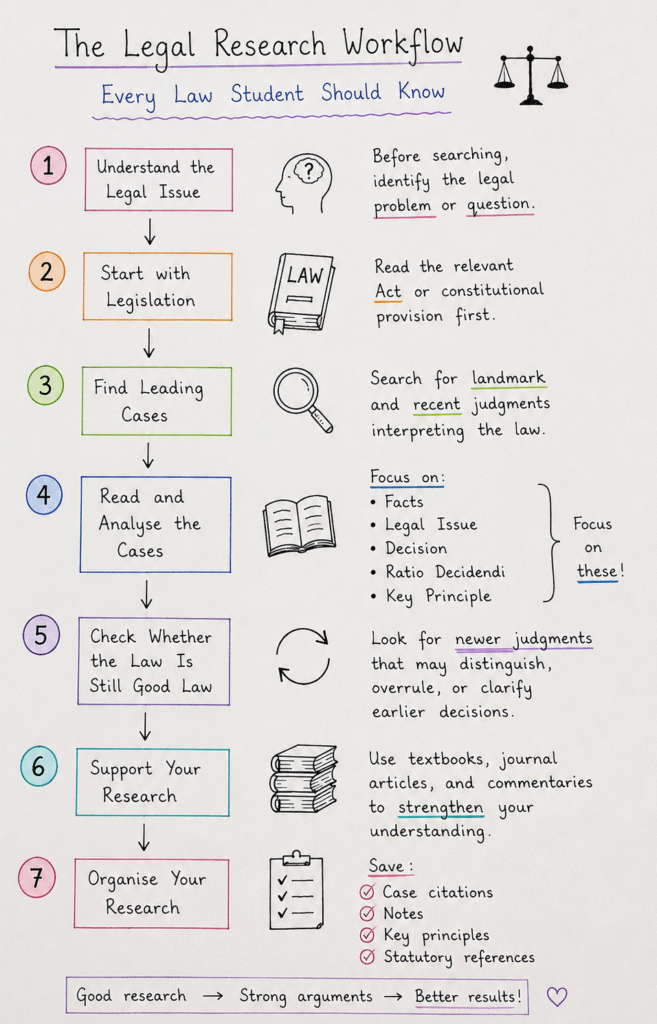
7. The Legal Research Workflow Every Law Student Should Know
Follow this simple step-by-step workflow whenever you research a legal issue.
8. Your Journey Starts Here
No article can teach you everything you’ll learn in law school—but it can help you start in the right direction.
The cases you’ll read, the lectures you’ll attend, and even the mistakes you’ll make will all become part of your journey. Focus on building strong fundamentals, stay curious, and never stop asking why. Those habits will take you much further than memorising legal principles ever will.
Whether you’re preparing for your first lecture or waiting for your first day of law school, remember this: every great lawyer was once a first-year student trying to make sense of it all.
Now it’s your turn.
Here’s to a successful start to your legal journey. Best of luck!
⚖️ Quick Legal Challenge
QUESTION
You find a wallet on the road containing cash and the owner’s ID. Instead of trying to return it, you keep it for yourself.
Have you committed an offence? Which section of the Penal Code applies, and what is the punishment?
📩 Send your answer to:
WhatsApp: +94 70 488 2646
or Email: info@aipazz.com
🎁 The first 5 students to answer correctly will receive 1 MONTH FREE AI Pazz access!