
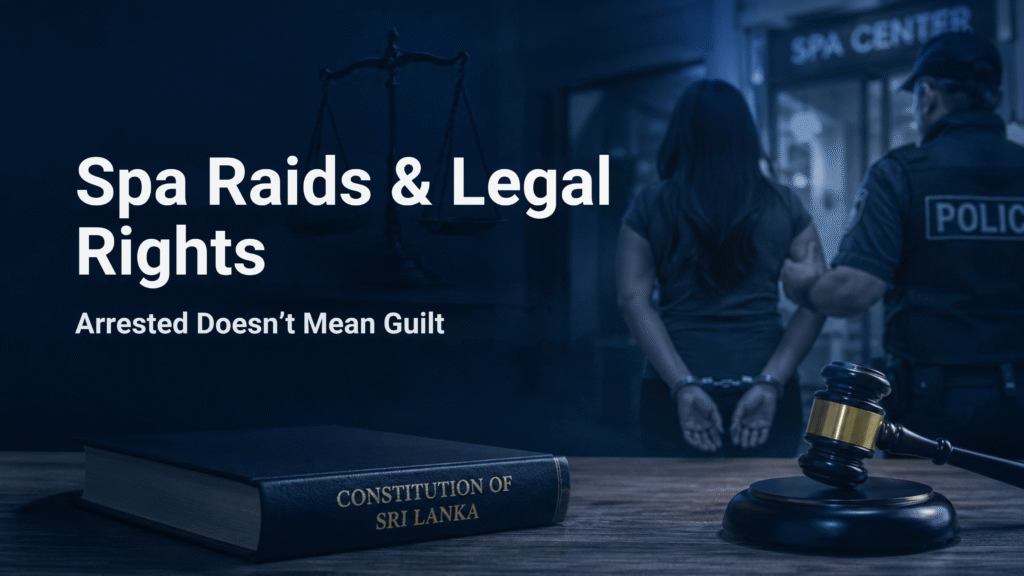
Is Prostitution Legal in Sri Lanka? What the Law Actually Says About Recent Spa Raids
The recent raids carried out by the Walana Central Anti-Vice Strike Force on several massage centres in Thalawathugoda, resulting in more than 40 arrests, have once again thrust Sri Lanka’s “spa industry” into the national spotlight.
As the story gained attention, many people reached the same conclusion – that everyone arrested had broken the law. But is that actually what Sri Lankan law says?
The legal position is more nuanced than many people realise.
While the law criminalises activities such as operating a brothel, procuring individuals for prostitution, human trafficking, and commercial exploitation, the legal position regarding prostitution itself is often misunderstood.
This has raised several important legal questions:
- Is prostitution actually illegal in Sri Lanka?
- Why do police raid massage centres?
- Does an arrest automatically mean someone is guilty?
- Can police or the media publicly identify people before a court reaches a decision?
- Are Fundamental Rights Being Violated
Understanding the answers requires looking beyond public opinion and examining what Sri Lankan law actually says.
01. Is Prostitution Illegal in Sri Lanka?
One of the biggest misconceptions in Sri Lanka is that prostitution itself is a criminal offence. However, the legal position is not that simple.
Sri Lankan law does not expressly criminalise consensual prostitution between adults in private. There is no single provision in the Penal Code that makes the act of prostitution itself a criminal offence.
However, this does not mean every activity connected to prostitution is legal.
Several related offences are criminalised under Sri Lankan law, including:
- Operating or managing a brothel.
- Procuring or recruiting individuals for prostitution.
- Living on the earnings of prostitution.
- Human trafficking and commercial sexual exploitation.
- Detaining or exploiting individuals for prostitution.
This distinction is important because it explains why police investigations often focus on organised commercial activities rather than prostitution itself.
02. Why Were the Recent Massage Centres Raided?
The recent police operation targeted several massage centres that were suspected of operating as brothels while presenting themselves as legitimate businesses.
Under Sri Lankan law, operating or managing a brothel is a criminal offence. These legal provisions are intended to prevent organized commercial exploitation rather than regulate private consensual conduct between adults.
If investigators establish that a premises was being used for the purpose of organised prostitution or that individuals were profiting from the prostitution of others, criminal liability may arise against owners, managers, organisers, or others involved in operating the establishment.
However, the presence of someone inside the premises does not automatically mean they have committed a criminal offence. Whether a person is an employee, therapist, receptionist, customer, manager, or someone involved in unlawful activity can only be determined through a proper investigation and, ultimately, by a court after considering the available evidence.
03. Why the Brothels Ordinance and Vagrants Ordinance Matter
While much of the public attention has focused on the recent spa raids, it is equally important to understand the laws that provide the legal basis for these police operations. Two key pieces of legislation are the Brothels Ordinance and the Vagrants Ordinance.
The Brothels Ordinance targets individuals who keep, manage, or profit from premises used as brothels, making it one of the primary legal tools used to address organised commercial sexual activity rather than prostitution itself.
The Vagrants Ordinance, particularly Section 7, has also been relied upon in cases involving alleged solicitation for the purpose of prostitution in public places.
In the context of the recent spa raids, these laws provide the legal framework for investigating suspected offences. However, whether a particular spa was operating as a brothel, or whether any individual committed an offence under these laws, can only be determined by a court after considering the available evidence. Until then, every person arrested remains entitled to the constitutional presumption of innocence and the protections afforded by due process.
04. Does Being Arrested Mean Someone Is Guilty?
No. An arrest does not mean someone is guilty.
An arrest simply means that the police suspect a person may have been involved in a criminal offence. It is the beginning of a legal investigation, not proof of guilt.
Whether an offence has actually been committed can only be determined by a competent court after considering the available evidence.
Until then, every arrested individual is entitled to the presumption of innocence and the legal protections that accompany it.
05. Can the Police or Media Publicly Identify Arrested Individuals?
One of the most debated aspects of the recent spa raids was the widespread circulation of photographs and videos showing women being escorted by police officers, often with their faces clearly visible. Within hours, these images had spread across news outlets and social media platforms, leading many people to publicly label those arrested as offenders.
However, publicly identifying individuals before their cases have been heard in court raises important legal and ethical concerns.
Publishing identifiable photographs or videos of arrested persons may cause lasting damage to their reputation, employment, family relationships, and personal dignity – even if they are later found not guilty or no charges are ultimately filed.
This concern becomes even more significant because not everyone present during a police raid has necessarily committed an offence. Some individuals may ultimately be employees, therapists, receptionists, customers, or others who were not directly involved in any alleged criminal activity. Their legal responsibility can only be determined through a proper investigation and, where necessary, by a court.
Responsible reporting should strike a balance between informing the public and respecting the legal rights of individuals. An arrest is part of an investigation, not a finding of guilt. Until a court reaches a decision, every person is entitled to be treated with fairness, dignity, and the presumption of innocence.
06. Are Fundamental Rights Being Violated?
Respecting human dignity and fundamental rights is a cornerstone of Sri Lanka’s legal system.
The public release of photographs and videos showing individuals in police custody raises important questions about constitutional rights and procedural fairness.
Under Article 13(5) of the Constitution of Sri Lanka, every person is presumed innocent until proven guilty by a competent court of law. This protection exists to ensure that individuals are not treated as criminals simply because they have been arrested or accused of an offence.
When identifiable images of arrested persons are circulated before their cases are heard, concerns may arise regarding privacy, dignity, and the presumption of innocence. While law enforcement agencies have the authority to investigate suspected criminal activity, those investigations should always be conducted in a manner that respects the constitutional rights of every individual.
Protecting fundamental rights is not only a legal obligation but also an essential part of maintaining public confidence in the rule of law.
Key Legal Takeaways
- Prostitution itself is not expressly illegal under Sri Lankan law.
However, many activities connected to organised commercial prostitution are considered criminal offences under existing laws. - Operating or managing a brothel is a criminal offence.
Those who organise, control, or financially benefit from such activities may face legal consequences if sufficient evidence is presented. - An arrest does not mean a person is guilty.
It only indicates that an investigation is underway, and any determination of guilt must be made by a court after reviewing the evidence. - Every accused person is presumed innocent until proven guilty.
This is a fundamental right protected under Article 13(5) of the Constitution, ensuring fairness in the legal process. - Publicly identifying individuals before trial can raise serious concerns.
Sharing photos or videos of suspects may harm their reputation, privacy, and future, even if they are later cleared of wrongdoing. - Law enforcement and media both have important roles.
While investigating and reporting are necessary, they should be carried out responsibly, respecting legal rights and due process. - It is important to distinguish between allegations and proven offences.
Legal conclusions should only be made after proper judicial review, not based on public opinion alone. - Not everyone found during a police raid has necessarily committed an offence.
Some individuals may ultimately be employees, therapists, receptionists, customers, or others who are not involved in any criminal activity. Their legal responsibility can only be determined through a proper investigation and, where necessary, by a court.
Conclusion
The recent spa raids have reignited an important national discussion about prostitution laws, brothel-related offences, media responsibility, and the constitutional rights of those accused of criminal offences. While Sri Lankan law empowers authorities to investigate organised criminal activity, it also requires that every individual be treated fairly and in accordance with due process.
As public debate continues, it is essential to distinguish legal facts from common misconceptions. Respecting the presumption of innocence, protecting individual dignity, and ensuring responsible reporting are not obstacles to justice. They are fundamental principles that strengthen public confidence in Sri Lanka’s legal system and uphold the rule of law.