
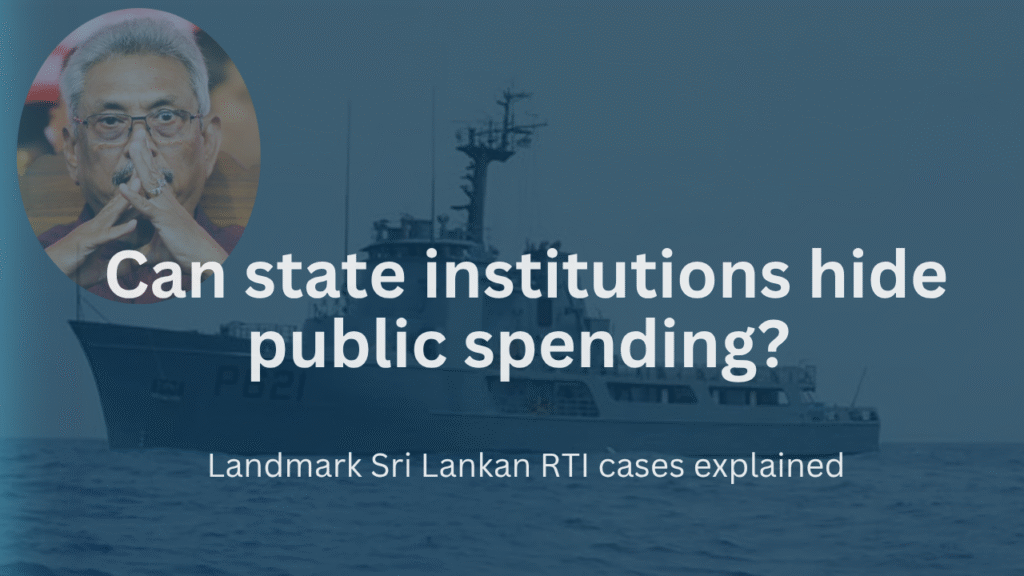
Can the navy hide public spending? Court says RTI cannot be blocked by vague ‘National Security’ claims.
Landmark Sri Lankan RTI Cases explained.
Title: Vice Admiral Priyantha Perera, Commander, Sri Lanka Navy v. A.A.M.R. Ali and Others
Case number: CA CA RTI 08/2023
Decided on: 2026-03-19
Before: Justice R. Gurusinghe, Justice Dr. Sumudu Premachandra
Introduction
In a landmark ruling on transparency and government accountability, the Court of Appeal of Sri Lanka held that the Sri Lanka Navy could not refuse to disclose information relating to the expenses incurred in transporting former President Gotabaya Rajapaksa aboard a naval vessel during the political crisis of July 2022.
The judgment addressed a growing tension within modern democracies: where should courts draw the line between national security and the public’s right to know? While the Navy argued that releasing operational expenditure details could indirectly expose sensitive military capabilities, the Court ultimately concluded that such claims must be supported by real evidence and not mere speculation.
The decision strongly reaffirmed that access to information is a constitutional right in Sri Lanka and that public authorities cannot rely on broad assertions of secrecy to avoid accountability.
Facts of the case
The dispute began after A.A.M.R. Ali filed a request under the Right to Information Act No. 12 of 2016 seeking details regarding the use of the naval vessel LNS Gajabahu during the departure of former President Gotabaya Rajapaksa from Sri Lanka in July 2022, a period marked by severe political unrest and public protests.
Although eight questions were initially raised, the core dispute before the Court concerned two specific requests:
- How much money was spent by the Sri Lanka Navy for the former President’s travel aboard the vessel?
- Who paid the relevant expenses, and when were those payments made?
The Sri Lanka Navy refused to disclose the information, relying on Section 5(1)(b)(i) of the RTI Act, which allows information to be withheld if disclosure would undermine national security, territorial integrity, or state defence.
Following an appeal, the Right to Information Commission directed the Navy to release the requested financial information. The Commander of the Navy then challenged that determination before the Court of Appeal.
Issues before the Court
The central issue before the Court was whether disclosure of the naval travel expenses connected to the former President’s evacuation would genuinely threaten national security.
The Court also had to determine the extent to which public authorities could rely on national security exemptions under the RTI Act and whether the Right to Information Commission had acted lawfully in directing disclosure.
Court’s reasoning
The Navy argued that even seemingly ordinary financial information could expose operational details of naval vessels. According to the Navy, disclosure of fuel costs and voyage expenditures could allow third parties to calculate a ship’s speed, operational range, fuel consumption patterns, and logistical dependencies, thereby creating security vulnerabilities.
However, the Court found these arguments unconvincing.
Justice Dr. Sumudu Premachandra observed that many of the details relied upon by the Navy were already publicly available or could easily be determined through open sources and standard ship specifications. The Court held that the alleged connection between the requested financial data and national security was too remote and speculative to justify withholding the information.
Importantly, the Court emphasized that Article 14A of the Constitution recognizes access to information as a fundamental right. Although that right may be restricted for legitimate national security reasons, such restrictions must be narrowly interpreted and properly justified.
The judges stressed that public authorities cannot make “blanket claims” of secrecy. Instead, they must demonstrate a clear and identifiable risk of serious harm to national security.
The Court also examined the relationship between the RTI Act and the Official Secrets Act No. 32 of 1955. While the Navy argued that disclosure would violate official secrecy protections, the Court pointed out that Section 4 of the RTI Act expressly states that the RTI Act prevails over inconsistent laws. As a result, secrecy claims could not automatically override the constitutional right to information.
A significant part of the judgment focused on international and comparative jurisprudence relating to freedom of information. The Court referred to decisions from India, Canada, and other jurisdictions emphasizing that transparency is the rule while secrecy remains the exception.
Particular reliance was placed on the famous Indian case State of Uttar Pradesh v. Raj Narain, where the Indian Supreme Court observed that citizens have the right to know about public acts carried out by public officials. The Court also referred to the Johannesburg Principles on National Security and Access to Information, which state that governments cannot invoke national security merely to avoid embarrassment or conceal wrongdoing.
The judges accepted that genuine military secrets and sensitive operational details deserve protection. However, they distinguished such classified material from ordinary financial information relating to public expenditure.
The Court ultimately concluded that the Navy had failed to establish any “demonstrable risk” linking disclosure of voyage expenses to actual prejudice to national security.
Decision
The Court of Appeal dismissed the Navy’s appeal and affirmed the order of the Right to Information Commission directing disclosure of the requested information.
The Court held that the Navy had failed to satisfy the legal threshold required under Section 5(1)(b)(i) of the RTI Act. Mere assertions of national security, without concrete evidence of harm, were insufficient to deny access to information.
The Court further emphasized that even where exemptions are claimed, Section 5(4) of the RTI Act requires disclosure where the public interest outweighs any possible harm.
No costs were awarded.
Significance of the Judgment
This decision is one of the strongest judicial affirmations of the Right to Information Act since its enactment in 2016. The judgment makes clear that national security cannot be used as a convenient shield against scrutiny of public expenditure.
The ruling is especially significant because it arose in the context of the dramatic events surrounding the departure of a sitting President during a national political crisis. By ordering disclosure, the Court reinforced the principle that citizens and taxpayers are entitled to know how public resources are used, even in politically sensitive situations.
The judgment also strengthens democratic accountability by establishing that secrecy must be justified through evidence rather than broad institutional claims. Public authorities must now demonstrate a real and proportionate connection between disclosure and potential harm to national security.