
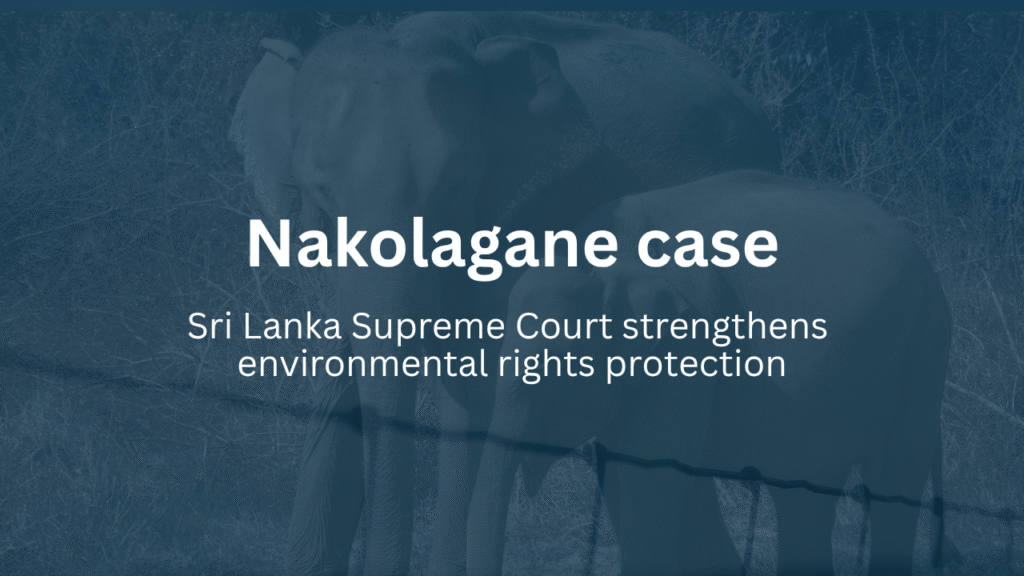
The Supreme Court’s decision in Centre for Environmental Justice v. Director General of Wildlife Conservation and Others marks an important development in Sri Lankan environmental jurisprudence. Delivered by Justice Janak De Silva on 6 May 2026, the judgment addressed large-scale forest destruction allegedly taking place within lands attached to the Nakolagane Purana Rajamaha Viharaya in the Kurunegala District.
Title: Centre for Environmental Justice v. Director General of Wildlife Conservation and Others
Case Number: SC FR 351/2022
Also known as: Nakolagane Case
Decided on: 6 May 2026
Before: Justice Janak De Silva, Justice Priyantha Fernando, Justice Dr. Sobhitha Rajakaruna, J.
Background of the Nakolagane case
The case concerned serious allegations of environmental destruction in the area surrounding the Nakolagane Purana Rajamaha Viharaya. The petition was filed by the Centre for Environmental Justice and two of its office bearers, who claimed that nearly 1,500 acres of forest land had been unlawfully cleared under the authority of the temple’s chief incumbent, Ven. Walathwawe Rahula Thero.
The dispute centered on a claim that the temple was entitled to approximately 4,500 acres of land under an ancient Kandyan-era “Sannasa.” According to the petitioners, portions of these lands had been leased or distributed for commercial activities such as agriculture, quarrying, and soil excavation.
Environmental concerns raised before court
The petitioners also alleged that unauthorized electric fences erected in the area had obstructed elephant migration routes, thereby intensifying the human-elephant conflict. The affected lands formed part of an environmentally sensitive zone surrounding the Palukadawala tank, an area important both for wildlife conservation and for the livelihoods of nearby farming communities dependent on irrigation and agriculture.
Several state agencies, including the Department of Wildlife Conservation, the Central Environmental Authority, the Department of Forest Conservation, the Department of Buddhist Affairs, and the Ceylon Electricity Board, were accused of failing to take meaningful action despite repeated complaints and inspections.
Issues before the Supreme Court
The principal issues before the Court were whether the large-scale environmental destruction and the inaction of public authorities amounted to a violation of the fundamental rights guaranteed under Articles 12(1) and 14(1)(g) of the Constitution.
The Court was required to determine whether the 10th Respondent could lawfully justify the disputed activities by relying on the alleged Sannasa grant, while also addressing preliminary objections concerning limitation and non-joinder before examining the merits of the case.
Evidence considered by the Court
In reviewing the evidence, the Court relied heavily on documents and reports submitted by state agencies, many of which confirmed that significant forest clearing had occurred and that the human-elephant conflict had worsened. Official reports further showed that the affected area was an important elephant habitat, that land had been cleared without necessary environmental approvals, and that parts of the temple land had been leased to third parties for commercial agricultural and industrial activities.
Recognition of environmental rights
One of the most significant aspects of the judgment was the Court’s recognition of environmental protection as an integral component of constitutional rights. Justice De Silva referred to Sri Lankan precedent, international environmental principles, and religious teachings from Buddhism, Hinduism, Christianity, Islam, and Roman legal traditions to emphasize the importance of stewardship over nature.
The Court relied heavily on earlier Sri Lankan authorities that interpreted Article 12(1) as encompassing a right to a clean and healthy environment. The judgment also referred to the 2025 Advisory Opinion of the International Court of Justice on climate change, which recognized that a clean, healthy, and sustainable environment is essential for the enjoyment of other human rights.
Failure of public authorities
The Court observed that the failure of public authorities to act despite repeated warnings and inspections constituted executive and administrative omissions capable of violating fundamental rights. The evidence demonstrated that state institutions had long been aware of the ecological damage but had failed to adequately enforce environmental laws or regulate the use of temple lands.
The Court’s analysis of temple property
The Court also carefully examined the legal framework governing Buddhist temple property under the Buddhist Temporalities Ordinance. Justice De Silva emphasized that temple property is not private property in the ordinary sense. A trustee or chief incumbent merely administers such property subject to statutory duties and restrictions. The Ordinance strictly regulates leasing arrangements and prohibits unauthorized alienation of temple lands.
The Court rejected the broad proprietary claim advanced by the 10th Respondent. Although the authenticity of the Sannasa itself was not conclusively disputed, the Court held that the Respondent had failed to establish that it had been properly registered under the Sannas and Old Deeds Ordinance. Consequently, the document could not be relied upon in support of his claim before Court.
More importantly, even the contents of the Sannasa did not support unrestricted commercial exploitation of the land. The Court noted that the grant was historically intended for the maintenance of the temple and religious purposes, not for personal or commercial gain. The judgment stressed that the ancient grant itself condemned the misuse or alienation of temple property for private benefit.
Procedural objections
On the procedural objections, the Court rejected the argument that the application was time-barred. Justice De Silva held that the alleged violations were continuing in nature because the environmental destruction and official inaction remained ongoing. The Court also dismissed the objection regarding non-joinder of parties, observing that procedural technicalities should not obstruct judicial scrutiny in matters involving serious public law concerns.
Findings of the Supreme Court
The Supreme Court held that the material before it clearly demonstrated large-scale deforestation, environmental degradation, and the worsening of human-elephant conflict in the area surrounding the temple lands and authorities had failed to properly discharge their statutory responsibilities despite having knowledge of the situation.
Accordingly, the Court found that the petitioners had successfully invoked the Court’s fundamental rights jurisdiction under Article 126 of the Constitution. The preliminary objections raised by the respondents were overruled, and the Court proceeded on the basis that the constitutional right to environmental protection formed part of the guarantee of equal protection under Article 12(1).
Significance of the Nakolagane case
The Nakolagane case is significant for several reasons.
- First, it strengthens the constitutional recognition of environmental rights in Sri Lanka by clearly linking environmental protection to fundamental rights jurisprudence. The decision reinforces the principle that state inaction in the face of ecological destruction can itself amount to a constitutional violation.
- Secondly, the judgment clarifies that temple lands remain subject to public law obligations and statutory regulation. Religious institutions and trustees cannot rely on historical grants to justify environmentally harmful commercial activity.
- Finally, the case represents an important affirmation of environmental governance and public trust principles. the Court positioned environmental protection not merely as a policy preference but as a constitutional imperative tied directly to human dignity, livelihood, and equality before the law.
Download Original Supreme Court Judgement – Nakolagane case