
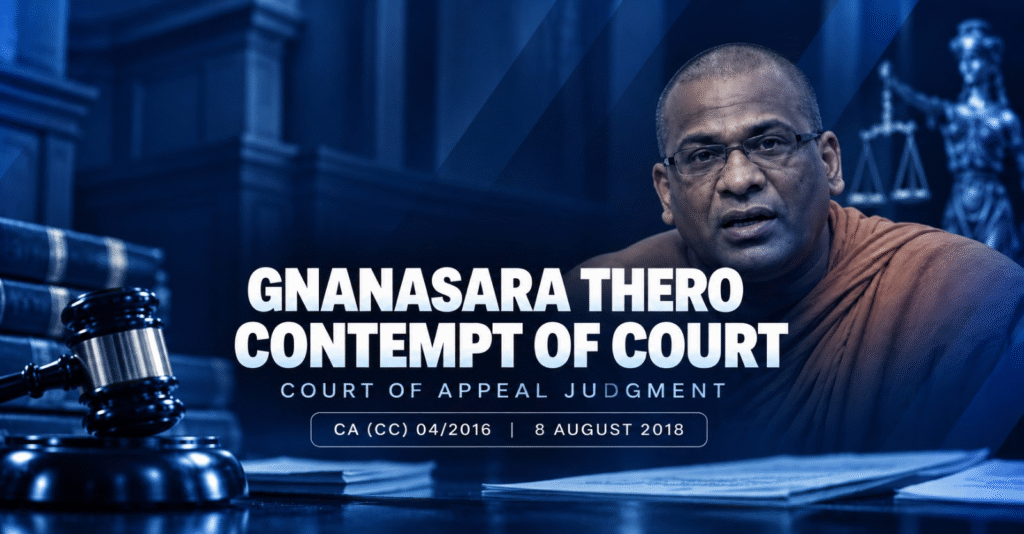
On 8 August 2018, Sri Lanka’s Court of Appeal convicted Galagodaaththe Gnanasara Thero on four counts of contempt of court arising from his conduct at the Homagama Magistrate’s Court on 25 January 2016.
The Court imposed four terms of rigorous imprisonment – four, four, six and five years and directed that they run concurrently. The effective sentence imposed by this judgment was therefore six years.
The decision in CA (CC) Application No. 04/2016 examines the Court of Appeal’s constitutional contempt jurisdiction, interference with judicial proceedings, and attempts to pressure a magistrate into changing a bail decision.
This article explains the findings in the 2018 contempt judgment. It does not describe the outcome of later appeals, pardon-related proceedings or separate criminal cases.
Gnanasara Thero contempt judgment: the case at a glance
Court: Court of Appeal of Sri Lanka
Case number: CA (CC) Application No. 04/2016
Related Magistrate’s Court reference: MC Homagama Case No. 40042
Judgment date: 8 August 2018
Date of the courtroom incident: 25 January 2016
Bench: P. Padman Surasena J., President of the Court of Appeal, and A. L. Shiran Gooneratne J.
Constitutional provision: Article 105(3)
Outcome: Conviction on all four contempt counts
Effective sentence imposed: Six years’ rigorous imprisonment, with all four sentences running concurrently
What happened at the Homagama Magistrate’s Court?
The incident occurred after the Magistrate refused bail to suspects in Case No. B 7417/2010 and proceeded to the next case.
According to the Court of Appeal’s findings, Gnanasara Thero stood up, approached the bench and addressed the Magistrate without express or implied permission. He was not a party to the proceedings and had attended in support of the suspects.
The Court found that his intervention was intended to secure their release on bail by pressuring the Magistrate to reverse the order already made. It characterised the address as coercive, rather than a plea, and found that it involved abusive, offensive and commanding language.
The Court also considered his statements rejecting the applicable law and his insulting address to Senior State Counsel Dileepa Pieris.
What were the four contempt charges?
The charges concerned four aspects of his conduct during the same courtroom incident:
- Unauthorised interference with proceedings: addressing the Court without permission, obstructing proceedings and challenging its authority.
- Defiance of the Court’s authority and the law: stating that the Court’s orders would not be accepted and that the country’s law should not be followed.
- An attempt to direct the bail decision: demanding that the Court grant bail to the suspects in Case No. B 7417/2010.
- Abusive treatment of prosecuting counsel: insulting Senior State Counsel Dileepa Pieris in open court in a manner that challenged and degraded the Court’s authority.
Gnanasara Thero pleaded not guilty. After considering the prosecution and defence evidence, the Court held that all four charges had been proved beyond reasonable doubt.
Five key findings in the judgment
1. The Court of Appeal could punish contempt of the Magistrate’s Court
A central defence argument was that the Court of Appeal should exercise its jurisdiction under Article 105(3) only in matters falling outside section 55(1) of the Judicature Act.
The Court rejected that argument. It held that Article 105(3) conferred broad constitutional authority to punish contempt of other courts, tribunals and institutions within its scope. It did not accept that section 55 restricted that constitutional power in the manner proposed by the defence.
This was an exercise of the Court of Appeal’s original contempt jurisdiction, rather than an appeal against the Magistrate’s bail order.
Judgment references: pages 37–44.
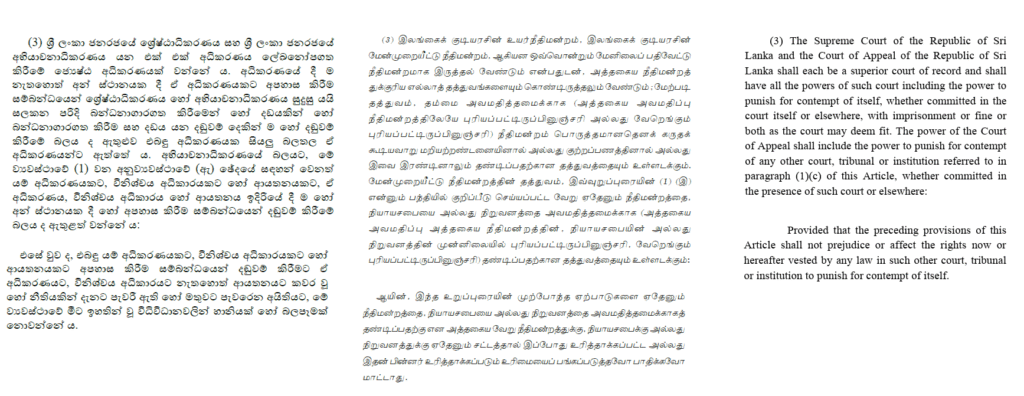
Section 105(3) of the Constitution
2. The Magistrate’s response did not amount to permission to speak
The Court examined whether the Magistrate had permitted the address, expressly or by implication.
Considering the contemporaneous notes, witness evidence and sequence of events, it found that no such permission had been given. The Magistrate’s efforts to warn or explain matters to Gnanasara Thero did not establish consent to the intervention.
Judgment references: pages 44–46.
3. The intervention was intended to intimidate the Magistrate
The Court found that the address was directed at obtaining a particular judicial outcome: bail for the suspects.
The timing was significant. The Magistrate had already refused bail and moved to the next case. The Court concluded that Gnanasara Thero was attempting to force the Magistrate to reverse that completed decision.
Its reasoning considered the words used, their tone, the surrounding circumstances and the accused’s own admissions.
Judgment references: pages 46–52.
4. Courts must apply the prevailing law irrespective of its origins
The Court addressed the statements rejecting laws because they had been made by foreigners.
It explained that courts administer justice according to the prevailing law, whether its origins are foreign or local. In the context of this incident, it treated those statements as a rejection of the authority under which the Magistrate had made the order.
Judgment references: pages 52–53.
5. All four charges were proved beyond reasonable doubt
The Court began with the presumption of innocence and assessed the evidence as a whole. It ultimately found that the prosecution had established every charge beyond reasonable doubt.
At sentencing, it emphasised the deliberate attempt to intimidate the Magistrate, the interference with counsel’s assistance and the absence of an apology to either court.
Judgment references: pages 53–55.
Was the sentence six years or nineteen years?
The effective sentence imposed was six years’ rigorous imprisonment.
The individual sentences were:
| Count | Sentence |
|---|---|
| Count 1 | Four years’ rigorous imprisonment |
| Count 2 | Four years’ rigorous imprisonment |
| Count 3 | Six years’ rigorous imprisonment |
| Count 4 | Five years’ rigorous imprisonment |
Although these terms total nineteen years arithmetically, the Court expressly ordered them to run concurrently. They operated together, rather than one after another, with the longest term being six years.
Judgment references: pages 55–56.
Why does this judgment matter?
The decision explains the Court of Appeal’s approach to conduct that obstructs proceedings or seeks to influence a judicial decision through intimidation.
Its reasoning centres on protecting the administration of justice: courts must be able to decide matters according to law without coercion or undue influence. The Court’s conclusion rested on the particular conduct, evidence and circumstances established in this case.
For legal professionals, the judgment is relevant to constitutional contempt jurisdiction, courtroom interference, the assessment of witness evidence and concurrent sentencing.
Citations
Frequently asked questions
When was the Gnanasara contempt judgment delivered?
The Court of Appeal delivered the judgment on 8 August 2018.
What is the case number?
The contempt proceeding is CA (CC) Application No. 04/2016.
Why was Gnanasara Thero convicted of contempt?
The Court found that he interfered with proceedings, challenged judicial authority, attempted to pressure the Magistrate to grant bail and insulted prosecuting counsel in open court.
Did the Court impose nineteen years in prison?
The four individual terms added up to nineteen years, but they were ordered to run concurrently. The effective sentence imposed by this judgment was six years’ rigorous imprisonment.
Did this judgment determine the guilt of the suspects in the underlying case?
No. It determined the contempt charges against Gnanasara Thero arising from his courtroom conduct, not the guilt of the suspects whose bail he sought.
Does this article explain his current legal position?
No. It explains the judgment delivered on 8 August 2018. Later proceedings and decisions must be examined separately.
Read the full Gnanasara Thero Contempt of Court Judgment
Download the Gnanasara Thero Contempt of Court Judgment — CA (CC) 04/2016, 8 August 2018
This article summarizes the supplied 2018 judgment for legal information and research. Always refer to the original judgment before citing or relying on its findings.